
In today’s rapidly evolving business environment, organisations must invest strategically in learning and development. A strong Academy Training Solution strategy and high-quality training solutions help companies stay competitive, agile, and innovative. As businesses increasingly recognise the value of development for employees, the role of a dedicated corporate training center and an advanced Academy Training Solution platform becomes central.
At UpSkill365, we deliver an integrated academy solution that hosts robust training courses designed to equip teams with the right skills, mindset and adaptability.

1.Why Academy Training Solution Matters
1.1 From one-time workshops to structured academies
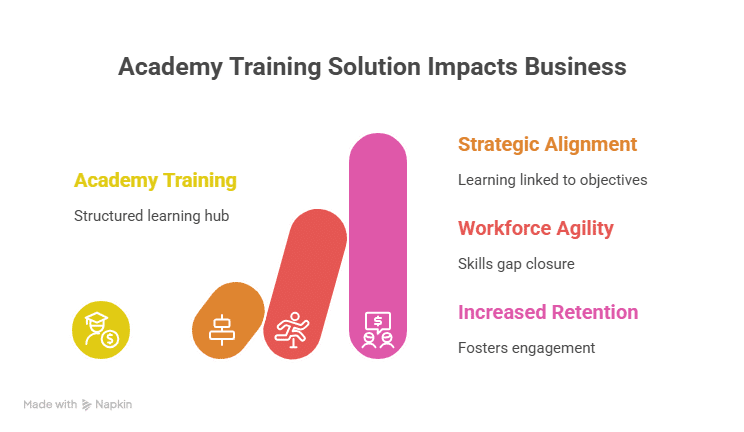
Traditionally, many organisations relied on ad-hoc one-off training sessions or workshops. While these have value, the more effective model today is a structured Academy Training Solution framework: a dedicated learning hub within the organisation (or through a partner) that offers a continuum of development opportunities, aligned to business goals and individual careers.
1.2 Linking training solutions to business strategy
Effective training solutions are not just about delivering courses; they are about aligning learning to strategic objectives. Research shows that companies that integrate training with business goals see greater impact. An academy model supports this alignment by operating at the intersection of talent development, business needs and learning infrastructure.
1.3 Building workforce agility and retention
In a world of fast-moving technologies, diverse multi-generational workforces and hybrid/remote work models, organisations must build agility and continuous learning cultures. A well-designed Academy Training Solution helps close skills gaps, foster engagement and increase employee retention.
2. The Role of a Corporate Training Center
2.1 Defining a Corporate Training Center
A corporate training center serves as the central hub for all organizational learning and development activities. It is a dedicated space physical, virtual, or a hybrid blend where employees engage in structured learning programs designed to enhance their skills, knowledge, and performance.
A well-designed training center goes beyond traditional classroom sessions. It incorporates multiple learning modalities such as instructor-led sessions, interactive workshops, virtual simulations, e-learning modules, and peer-to-peer knowledge sharing. The goal is to create an engaging, flexible learning environment that caters to diverse learning styles and business objectives.
In today’s evolving business landscape, where continuous upskilling and reskilling are essential, a corporate training center functions as a strategic enabler aligning workforce development with organizational growth. It ensures that learning is not an isolated activity but a continuous, measurable process that strengthens both individual and corporate performance. When integrated within an Academy Training Solution, the corporate training center becomes a strategic framework that drives learning consistency, scalability, and measurable business outcomes.
2.2 Key Features to Look For
When building or choosing a corporate training center as part of your Academy Training Solution, organizations should consider several critical features that ensure both effectiveness and long-term scalability:
• Modern Facilities or Robust Virtual Platforms:
For physical centers, state-of-the-art classrooms, labs, and collaboration spaces are essential. In virtual or hybrid setups, a secure, high-performing learning platform capable of hosting live sessions, webinars, and self-paced modules ensures uninterrupted learning experiences.
• Accessibility and Flexibility:
A strong training center should accommodate learners across multiple time zones, locations, and devices. Compatibility with desktops, tablets, and smartphones helps ensure inclusivity and convenience, allowing employees to learn anytime, anywhere.
• Integration with the Learning Ecosystem:
The center should seamlessly connect with the organization’s Learning Management System (LMS), HR systems, and analytics tools. This integration enables easy tracking of learner progress, certifications, and performance data an essential component of an effective Academy Training Solution.
• Customization and Personalization:
No two organizations are the same. A robust training center must allow customization of content, modules, and delivery methods to align with company goals, industry requirements, and employee roles. Tailored learning paths within an Academy Training Solution ensure relevance and impact for every learner.
• Measurement and Evaluation of Learning Outcomes:
Effective corporate training centers include data-driven assessment tools to measure engagement, retention, and performance improvement. These insights help refine programs continuously, ensuring maximum ROI and supporting the long-term success of your Academy Training Solution.
2.3 How UpSkill365’s Corporate Training Center Works
At UpSkill365, our Corporate Training Center forms the foundation of our Academy Training Solution, designed to empower organizations with a complete, scalable learning ecosystem.
Our center integrates technology, content, and analytics to deliver a seamless learning experience that adapts to your organization’s needs. The infrastructure supports a wide spectrum of programs from foundational skill development to advanced leadership and technical training, all delivered through a blended learning model that combines virtual and instructor-led components.
Here’s how it works:
• Centralized Learning Hub:
All training initiatives are managed within a unified platform, ensuring consistency, accessibility, and transparency across departments and geographies.
• Adaptive Delivery:
UpSkill365 supports multiple training modes, including live online sessions, recorded modules, collaborative workshops, and on-site sessions. This flexibility allows learners to engage in ways that suit their schedules and learning preferences, forming an integral part of the Academy Training Solution experience.
• Custom Program Design:
Each organization can tailor programs to specific business goals, job roles, or performance objectives. From onboarding to executive development, the training content evolves with your company’s needs, ensuring your Academy Training Solution stays relevant and impactful.
• Analytics & Performance Tracking:
Our data-driven framework monitors learner engagement, progress, and outcomes. Reports and insights help HR and L&D teams evaluate effectiveness, refine strategies, and align learning with organizational KPIs maximizing the value of the Academy Training Solution.
• Scalable & Consistent Delivery:
With UpSkill365’s training center, your business gains a sustainable, scalable foundation for all training initiatives. Whether you’re onboarding new employees or developing senior leaders, our system ensures that every learning experience is consistent, measurable, and impactful.
In essence, UpSkill365’s Corporate Training Center, powered by the Academy Training Solution, transforms the way organizations deliver learning. It turns training into a strategic advantage that drives growth, productivity, and innovation across the enterprise.
3. The Power of an Academy Training Solution Platform
3.1 Why a platform matters
A training platform is the digital backbone of any modern academy solution. It enables course delivery, tracking, assessment, reporting and learner engagement. According to research, scalable training solutions rely on cloud-based platforms, mobile access, modular design and analytics.
3.2 Key capabilities
When choosing or designing an academy training platform, important features include:
- Modular design that supports growth and updates
- Mobile and micro-learning support (allows learning anytime/anywhere)
- Analytics dashboard: measuring learner progress, business impact
- Social/peer learning and gamification to boost engagement
- Integration with HR systems, career-pathing and talent management
3.3 UpSkill365’s academy platform in practice
UpSkill365 offers an Academy Training Solution platform that is designed to:
- Host comprehensive training courses (technical, soft skills, leadership)
- Provide blended modalities (virtual instructor-led, on-demand e-learning, micro-modules)
- Enable corporate clients to track metrics, learner progress and ROI
- Allow customised versions aligned with specific business units or geographies
-
Training Courses Offered – A Deep Dive
4.1 Foundational Skills Courses
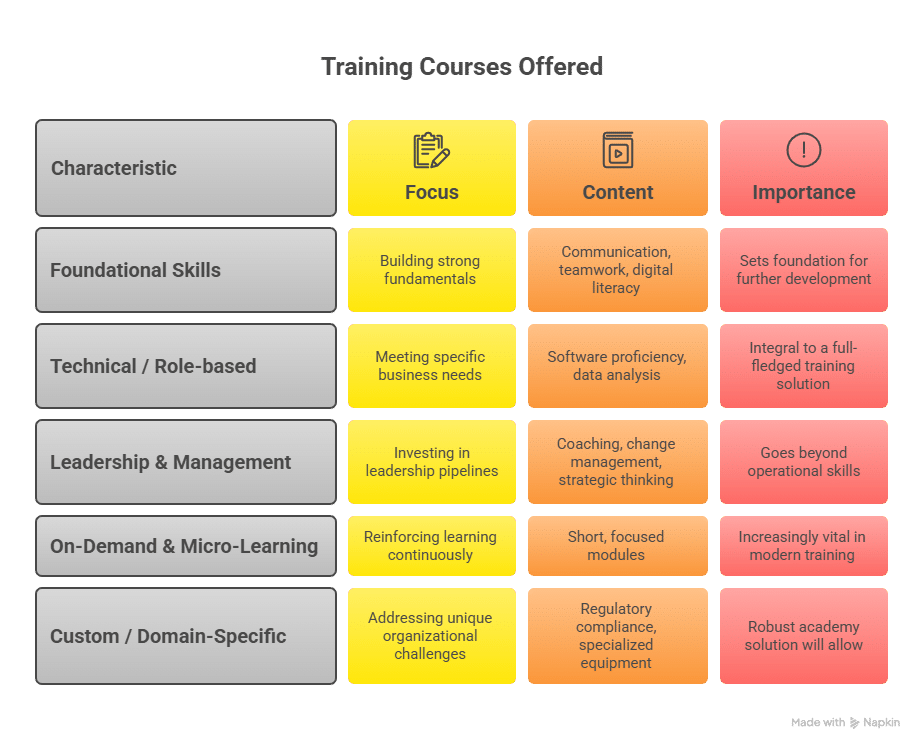
Every academy solution should begin by building strong fundamentals whether in areas such as communication, teamwork, digital literacy or compliance. These training courses set the foundation for further development and a culture of learning.
4.2 Technical / Role-based Courses
To meet business needs, organisations need role-specific training: software proficiency, data analysis, process optimisation, product knowledge, domain-specific skills. Such courses are integral to a full-fledged training solution. As industry articles observe, both technical skills and soft skills remain important in corporate training.
4.3 Leadership & Management Development
True academy training goes beyond operational skills and invests in leadership pipelines. Courses might cover coaching, change management, strategic thinking, performance management, and organisational culture.
4.4 On-Demand and Micro-Learning Modules
Short, focused modules (micro-learning) are increasingly vital in modern training solutions because they fit into busy workflows and help reinforce learning continuously.
4.5 Custom / Domain-Specific Training
Different organisations face different challenges. A robust academy solution will allow the creation of tailor-made courses whether for regulatory compliance, specialised equipment training, or process change. For example, studies show that the best training solutions for large enterprises involve gamified learning platforms, mentoring/coaching and tailored content.
5. Designing an Effective Training Solution
5.1 Needs analysis & alignment
The first step to a high-impact training solution is a solid needs assessment: identify skill gaps, business objectives, learner profiles and performance metrics. Without this alignment, training may be generic and lose impact.
5.2 Setting clear objectives and KPIs
Define what success looks like: improved productivity, fewer errors, higher customer satisfaction, leadership readiness, etc. Set measurable targets before rolling out the training programme.
5.3 Choosing the right modalities
Consider the mix of live instructor-led training, e-learning, micro-modules, peer learning, coaching, simulations. A blended approach often leads to higher engagement and knowledge retention.
5.4 Launching and managing the academy
The launch phase should include learner orientation, communication campaigns, scheduling, platform access, mentor/coaches and follow-up mechanisms. This is where the corporate training centre and training platform play critical roles.
5.5 Measuring impact & continuous improvement
Post-training measurement is key. Collect learner feedback, assess knowledge retention, evaluate behavioural change, link results to business outcomes. A modern academy training solution emphasises ongoing review and improvement.
6. Benefits of Using UpSkill365’s Academy Training Solution
6.1 Consistent global delivery
Because the UpSkill365 platform and training centre are designed to scale, organisations with multiple geographies can deliver consistent learning experiences across locations, ensuring alignment, uniformity and quality.
6.2 Increased learner engagement
Through a well-designed academy training platform, micro-learning modules, gamification, interactive workshops and blended learning, UpSkill365 helps increase learner motivation and participation.
6.3 Work-flow friendly training
With modular, mobile-accessible training courses, learners can engage across devices, on their own schedules, reducing downtime and increasing flexibility.
6.4 Measurable ROI
By aligning the training solution with business objectives and deploying tools for measurement, your organisation can track the impact of the academy training: e.g., improved performance metrics, reduced errors, better retention, stronger leadership pipeline.
6.5 Talent development & retention
Investing in an academy solution signals to your workforce that you care about their growth. That helps strengthen employer brand, boost morale, and reduce attrition — especially among high-potential talent.
7. Challenges and How to Overcome Them
7.1 Low learner engagement
Some training programmes struggle because learners see them as mandatory or irrelevant. To overcome this, ensure relevancy (link to real jobs), use blended modalities, make training accessible and engaging, embed micro-learning, and tie it to career paths.
7.2 Scaling training globally
When operating across multiple regions, ensuring cultural relevance, local language support, time-zone compatibility and consistent quality can be difficult. A strongAcademy Training Solution platform and central centre helps maintain standardisation while allowing localisation. As one study notes, scalable learning systems are key to large enterprises.
7.3 Measuring impact
Often training is delivered but the business impact is unclear. To overcome this, define KPIs upfront, collect data (participation, assessment scores, performance metrics), and connect back to business outcomes.
7.4 Continual updating
Technology, roles and business needs change fast. Training courses can become stale unless they are updated regularly. An academy training platform with modular architecture and prioritised content review helps stay current.
8. Why Choose UpSkill365 for Your Academy Training Solution
- Tailored training courses across foundational, technical, leadership and custom domains
- A dedicated corporate training centre for seamless delivery
- A robust academy training platform built to scale, drive engagement and provide analytics
- Alignment of training solutions with business strategy and measurable outcomes
- End-to-end support: needs assessment → course design → delivery → evaluation → continuous improvement
9. Implementation Roadmap for UpSkill365’s Academy Training Solution
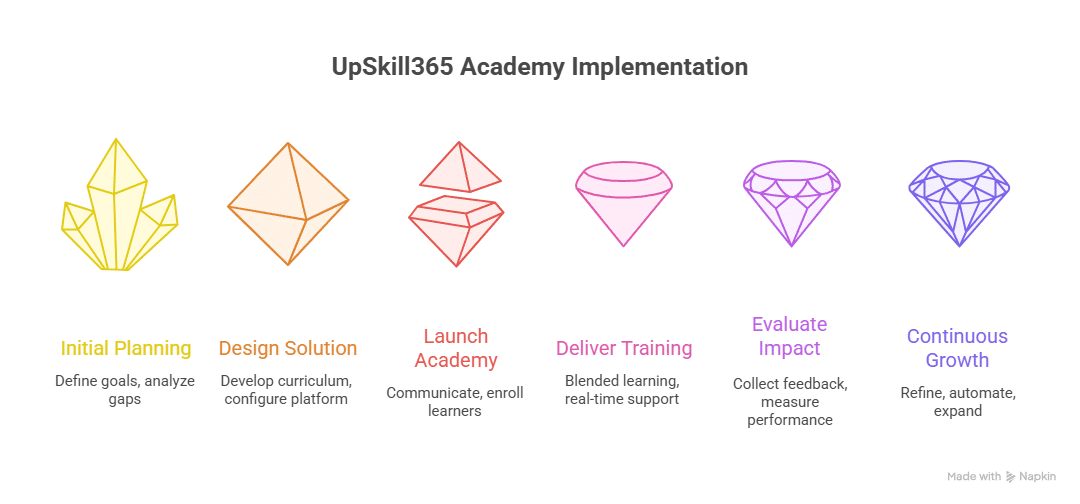
1. Assessment & Planning
-
Define Strategic Goals: Identify business objectives aligned with workforce transformation — such as improving productivity, enhancing digital skills, or preparing teams for new technologies.
-
Conduct Skill Gap Analysis: Evaluate current competencies versus future skill needs using surveys, performance data, and manager insights.
-
Segment Learner Cohorts: Categorize employees based on departments, experience levels, or learning objectives to personalize training paths.
-
Establish KPIs & Success Metrics: Set measurable goals (e.g., training completion rate, skill proficiency growth, employee retention, and project performance).
-
Project Governance: Form a cross-functional implementation team including HR, L&D, and technical leads to oversee execution.
2. Design Solution
-
Curriculum Development: Choose the right mix of courses — foundation, technical, leadership, and custom programs tailored to business goals.
-
Learning Path Configuration: Map learning journeys for different roles, ensuring progression from basic to advanced modules.
-
Platform Setup: Configure UpSkill365’s training portal — including content libraries, assessments, gamification, and user dashboards.
-
Onboarding Plan: Prepare onboarding materials such as welcome videos, platform navigation guides, and learning FAQs to ensure smooth adoption.
-
Integration: Connect with existing HRMS, LMS, or CRM tools for seamless tracking and analytics.
3. Launch
-
Communication Strategy: Announce the initiative organization-wide through internal newsletters, intranet, and management briefings.
-
Enrollment & Scheduling: Register learners, assign courses, and publish training calendars.
-
Orientation Sessions: Conduct introductory workshops or webinars to familiarize learners with the academy’s objectives and platform features.
-
Stakeholder Engagement: Ensure leadership visibility through endorsement messages and participation to boost motivation.
4. Delivery
-
Blended Learning Rollout: Deliver programs through a combination of instructor-led training (ILT), virtual classrooms, e-learning modules, and micro-learning capsules.
-
Real-Time Support: Offer mentorship, discussion forums, and expert Q&A sessions to maintain engagement.
-
Progress Tracking: Monitor attendance, engagement levels, and completion rates using analytics dashboards.
-
Continuous Engagement: Use gamification elements like badges, leaderboards, and certifications to sustain learner motivation.
5. Evaluation
-
Feedback Collection: Conduct post-training surveys and one-on-one interviews to assess satisfaction and perceived impact.
-
Performance Measurement: Compare pre- and post-training assessments to gauge skill improvement.
-
Behavioural & Business Impact: Evaluate changes in on-the-job performance, productivity, and alignment with strategic KPIs.
-
Reporting: Generate detailed reports for HR and management teams for decision-making and ROI analysis.
6. Iterate & Scale
-
Refinement: Update training modules based on feedback, emerging technologies, and evolving business needs.
-
Advanced Learning Paths: Introduce specialization tracks, leadership programs, and certification partnerships.
-
Automation & AI Integration: Utilize AI-driven recommendations and adaptive learning to personalize experiences at scale.
-
Expansion: Extend the academy solution to additional departments, business units, or geographies.
-
Corporate Training Centre Growth: Evolve the initiative into a full-fledged corporate training ecosystem — supporting both in-house talent development and external partnerships.
Academy Training Solution
-
10. Frequently Asked Questions (FAQs)
Q1: What is the difference between a training course and an academy training solution?
An individual training course is a specific module or programme (e.g., “Leadership Essentials”). An academy training solution is a broader ecosystem that includes multiple courses, platform infrastructure, corporate training centre, learner support, analytics and continuous improvement.
Q2: How does an academy training platform differ from a standard LMS?
A standard LMS delivers courses and tracks learner data. An academy training platform goes further, incorporating modular design, mobile/micro-learning, analytics dashboards tied to business outcomes, social learning, and integration with talent/HR systems.
Q3: Can small and medium businesses benefit from an academy training model?
Absolutely. While larger enterprises often lead in structured academy solutions, smaller organisations can also adopt scaled-down versions: a training centre (physical or virtual), an integrated platform, and targeted training courses aligned to business needs. The key is alignment and relevance.
Q4: How do we measure the ROI of our training solution?
Start by defining KPIs up front (e.g., improved productivity, reduced errors, faster onboarding, higher customer satisfaction). Use data from the training platform (participation rates, assessment scores), follow-up performance metrics, and feedback to evaluate impact.
Q5: How often should training content be updated?
Regularly. Given rapid shifts in technology, roles and business strategy, training content should be reviewed and refreshed annually (or more frequently) to ensure relevance and to keep learners engaged.
Q6: What modalities of delivery are included in UpSkill365’s academy training?
UpSkill365 offers a mix: instructor-led workshops (physical/virtual), e-learning modules, mobile micro-learning units, peer/co-coach sessions, simulations and blended formats to accommodate different learning styles and workflows.
Q7: How do we ensure learner engagement and avoid training fatigue?
Make the training relevant and tied to real job roles, use shorter micro-learning modules, apply gamification or social learning elements, track progress and reward achievements, and schedule training in a way that fits into normal work flows.
Q8: Can the academy training solution be applied globally, across multiple geographies?
Yes. With a robust academy training platform, central management of the corporate training centre, localisation (language, culture) and modular course structure, training solutions can scale globally. The “scalable learning systems” approach is key.
Q9: How do we integrate training courses into performance and career development?
By mapping training modules to specific roles and career levels, linking completion to career pathways, incorporating within talent management processes, and engaging managers to support and coach learners. This makes training part of the organisation’s culture rather than a one-time event.
Q10: What makes UpSkill365 unique compared to other training vendors?
UpSkill365 provides end-to-end academy training: from needs assessment through to delivery and measurement, using a dedicated corporate training centre and an advanced Academy Training Solution platform. This integrated approach ensures consistency, scalability and business alignment going beyond standalone training courses to a strategic learning ecosystem.
Conclusion
In the modern business environment, the need for robust academy training, effective training solutions, and a dedicated corporate training center is more pronounced than ever. Companies that treat training as a strategic investment rather than a compliance checkbox gain a competitive edge, motivated employees and a learning culture that supports change.
By partnering with UpSkill365, organisations gain access to a full-fledged Academy Training Solution platform and the breadth of training courses required for foundational, technical and leadership development. The academy solution we provide is scalable, measurable and aligned with your business vision.
If you’re ready to elevate your talent development strategy, invest in a training ecosystem that delivers real outcomes, and build a future-ready workforce, speak to UpSkill365 about how we can design your academy training solution together.