
In a world where everyone wants to speak, present, persuade, and lead, very few professionals are intentionally trained to listen. Yet the most successful organizations consistently share one common trait: they cultivate a culture where listening is not passive — it is powerful.
Listening skills training is not just another soft skills workshop. It is a strategic development program that reshapes communication habits, improves leadership impact, strengthens team dynamics, and drives measurable business outcomes. While many companies invest heavily in presentation skills or negotiation strategies, the ability to truly understand others often remains underdeveloped.
This article explores listening from a fresh perspective — not as a basic communication skill, but as a competitive advantage in the modern workplace.
Why Listening Is the Most Underrated Workplace Skill
Most professionals believe they are good listeners. However, research and workplace observations repeatedly show a different reality. Employees frequently:
- Interrupt before a speaker finishes
- Mentally prepare responses instead of processing information
- Filter messages through personal bias
- Miss emotional cues
- Multitask during conversations
The result? Miscommunication, tension, lost productivity, and weakened trust.
Listening skills training challenges the illusion that hearing equals understanding. It teaches individuals to shift from reactive communication to intentional engagement. In today’s fast-moving work environment, this shift can dramatically reduce workplace friction.
The Hidden Cost of Poor Listening in Organizations
Companies rarely calculate the financial cost of poor listening — yet it is significant.
Misunderstood instructions lead to project delays. Incomplete client information causes service errors. Ignored employee feedback results in turnover. Escalated conflicts drain management time. All of these issues often trace back to one root cause: ineffective listening.
Without structured listening skills training, organizations unknowingly allow communication breakdowns to multiply. Leaders may assume that problems stem from technical incompetence when the real issue is simply that people are not truly hearing one another.
Strong listening reduces repetition, minimizes conflict, and prevents avoidable mistakes. It protects time, morale, and revenue.
What Makes Listening Skills Training Different from General Communication Courses
Many communication workshops focus on speaking clearly or delivering persuasive presentations. Listening skills training, however, reverses the spotlight.
Instead of asking, “How can I express myself better?” it asks, “How can I understand others more deeply?”
This shift includes:
- Developing mental discipline to stay present
- Recognizing emotional undertones in conversations
- Managing internal reactions before responding
- Asking thoughtful follow-up questions
- Validating understanding through paraphrasing
Unlike surface-level seminars, effective listening skills training requires self-awareness. Participants examine their listening habits, triggers, and assumptions. They learn to identify when they are listening to respond rather than listening to understand.
The Psychology Behind Effective Listening
Listening is not simply an external behavior — it is a cognitive and emotional process. When someone speaks, the listener’s brain processes words faster than the speaker can deliver them. This “mental gap” often leads to distraction.
Listening skills training teaches participants how to manage this gap by:
- Practicing focused attention
- Reducing internal dialogue
- Recognizing judgment patterns
- Staying curious rather than defensive
Neuroscience shows that feeling heard activates trust and reduces stress responses. When employees perceive that their ideas are genuinely considered, psychological safety increases. Teams become more collaborative and innovative.
Listening, therefore, is not just polite — it is neurologically powerful.
The Four Levels of Workplace Listening
One unique way listening skills training reframes communication is by introducing levels of listening awareness.
1. Surface Listening
At this level, the listener hears words but gives minimal attention. Multitasking and distraction dominate. Misunderstandings are common.
2. Selective Listening
The listener focuses only on information that confirms existing beliefs or interests. Critical details may be ignored.
3. Active Listening
The listener engages intentionally, asks clarifying questions, and summarizes key points.
4. Empathic Listening
At the highest level, the listener seeks to understand not only the message but also the emotion and intention behind it.
Listening skills training helps participants move progressively toward deeper levels, especially in high-stakes conversations.
How Listening Impacts Leadership Credibility
Leadership authority no longer depends solely on expertise. Modern employees expect leaders to be approachable and responsive.
When managers fail to listen:
- Employees disengage
- Innovation decreases
- Feedback is withheld
- Trust erodes
On the other hand, leaders who complete listening skills training often experience a noticeable shift in team behavior. Employees contribute more openly. Meetings become more productive. Conflicts de-escalate faster.
Listening strengthens credibility because it communicates respect. It signals that leadership decisions are informed rather than imposed.
Listening Skills Training in Hybrid and Remote Work Environments
Remote communication introduces new challenges. Without physical presence, subtle cues such as posture, tone shifts, or facial expressions may be missed. Digital fatigue also reduces attention spans.
Listening skills training adapts to these realities by teaching professionals how to:
- Minimize digital distractions
- Confirm understanding more explicitly
- Use verbal acknowledgment effectively
- Pay closer attention to tone and pacing
- Create structured turn-taking in virtual meetings
In distributed teams, clarity depends even more on intentional listening behaviors. Without them, misunderstandings multiply quickly.
Transforming Workplace Conflict Through Better Listening
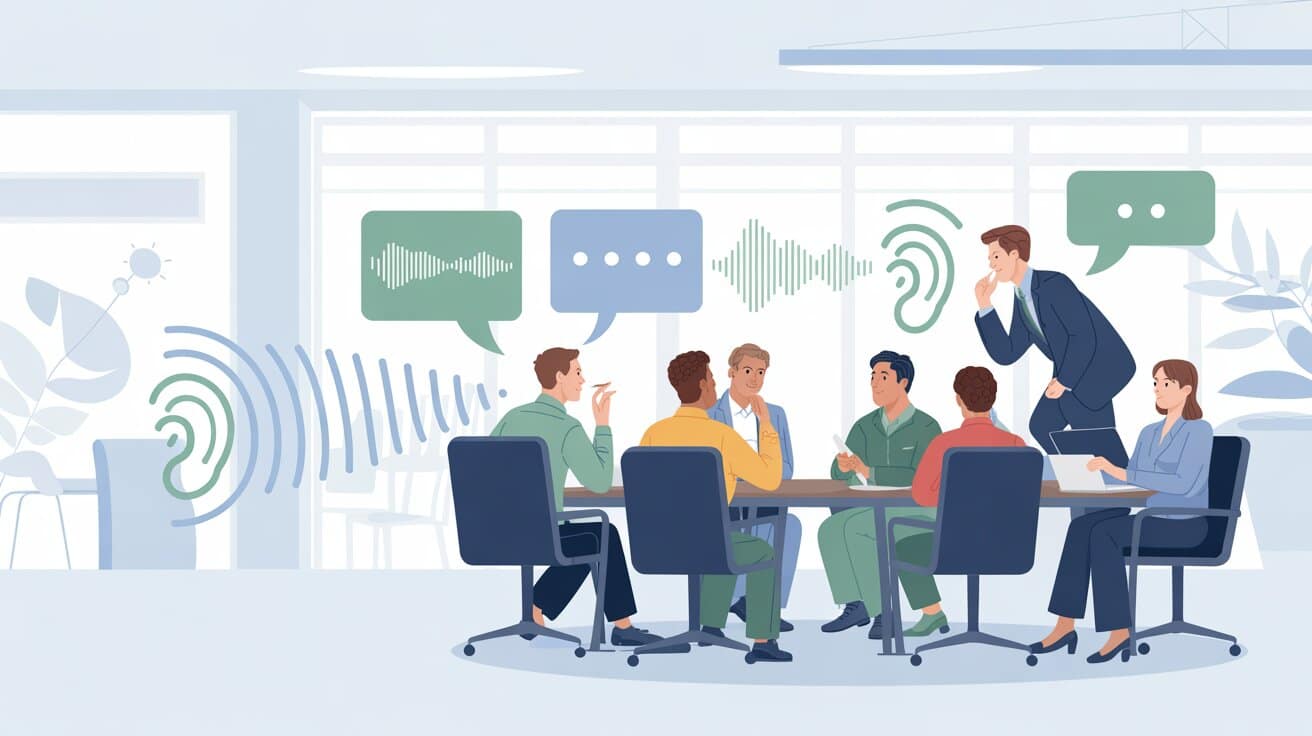
Conflict often escalates not because of major disagreements, but because individuals feel unheard.
Listening skills training introduces structured techniques for conflict conversations, including:
- Allowing uninterrupted speaking time
- Reflecting back what was heard
- Identifying shared goals
- Separating emotion from assumption
- Avoiding defensive language
When people feel genuinely understood, their need to “win” decreases. Dialogue becomes solution-oriented rather than adversarial.
Listening shifts conversations from confrontation to collaboration.
Practical Exercises Used in Listening Skills Training
To create lasting behavioral change, listening skills training includes experiential activities rather than passive lectures.
Some impactful exercises include:
- Silent summarization drills
- Emotion-identification practice
- Perspective-switch role play
- Bias-awareness reflection tasks
- Interrupt-resistance challenges
Participants often discover surprising habits, such as finishing others’ sentences mentally or dismissing ideas prematurely. Awareness is the first step toward change.
Repeated practice strengthens listening as a conscious discipline rather than an automatic reaction.
Measuring the Success of Listening Development Programs
Organizations may question how to evaluate improvements in listening. Although it is a behavioral skill, results can be measured.
After implementing listening skills training, companies frequently observe:
- Shorter and more efficient meetings
- Reduced workplace complaints
- Improved employee engagement scores
- Increased cross-department collaboration
- Higher client satisfaction ratings
Feedback surveys, 360-degree evaluations, and manager observations help track progress. Over time, listening becomes embedded in company culture rather than treated as a temporary initiative.
Why Listening Is a Strategic Business Advantage
In competitive markets, innovation depends on idea-sharing. Customer retention depends on understanding needs. Employee retention depends on feeling valued.
Listening skills training strengthens all three areas.
When organizations listen:
- Customers feel respected
- Employees feel motivated
- Leaders make informed decisions
- Problems are addressed early
- Creativity expands
Listening is not passive — it is proactive intelligence gathering. It reveals insights that data alone cannot capture.
Companies that master listening build reputations for responsiveness and trustworthiness.
Integrating Listening into Organizational Culture
For listening to become sustainable, it must move beyond a one-time workshop. Organizations can reinforce listening skills training by:
- Modeling listening at executive levels
- Incorporating listening metrics into performance reviews
- Establishing meeting norms that prevent interruption
- Encouraging reflective questioning
- Recognizing employees who demonstrate strong listening behaviors
Cultural transformation begins when listening becomes an expectation, not an exception.
The Future of Workplace Communication
As artificial intelligence, automation, and digital tools continue to reshape industries, human connection remains irreplaceable. While technology processes information, people interpret meaning.
Listening skills training prepares professionals for this future by strengthening empathy, clarity, and trust. These qualities cannot be automated.
In rapidly evolving environments, the ability to listen deeply will distinguish adaptable leaders from reactive ones. It will determine whether teams collaborate effectively or fragment under pressure.
Conclusion: Listening as a Leadership Multiplier
Listening is often mistaken for silence. In reality, it is active engagement, disciplined attention, and intentional understanding.
Listening skills training transforms communication from a routine exchange into a strategic connection. It reduces conflict, strengthens leadership, increases productivity, and enhances workplace culture.
In organizations where everyone competes to be heard, those who choose to truly listen gain influence without force. They build trust without demand. They solve problems before they escalate.
The future of workplace excellence does not belong to those who speak the loudest. It belongs to those who listen the best.
FAQ
- What makes UpSkill354’s Listening Skills Training different from other workplace communication programs?
UpSkill354 focuses on practical, actionable listening techniques rather than just theory. Our training emphasizes active listening, empathy, and critical understanding, ensuring participants can immediately apply skills in real workplace scenarios. We blend interactive exercises, role-plays, and personalized feedback for measurable results.
- How can Listening Skills Training from UpSkill354 improve team productivity and collaboration?
Effective listening reduces misunderstandings, streamlines communication, and fosters trust among team members. By applying skills learned from UpSkill354’s program, employees collaborate more efficiently, solve conflicts faster, and make informed decisions, leading to higher productivity and smoother workflows.
- Who should attend UpSkill354’s Listening Skills Training sessions in a workplace setting?
Our training is ideal for team leaders, managers, HR professionals, project coordinators, and frontline employees. Essentially, anyone who interacts regularly with colleagues, clients, or stakeholders can benefit from stronger listening skills to enhance workplace performance.
- Does UpSkill365 offer customized Listening Skills Training for specific industries or roles?
Yes! UpSkill365 tailors programs to suit industry-specific needs, whether it’s corporate offices, healthcare, customer service, IT, or manufacturing. Customized modules focus on role-relevant listening challenges and solutions to maximize workplace impact.
- What measurable outcomes can organizations expect after completing UpSkill354’s Listening Skills Training?
Organizations typically see improved team communication, reduced conflicts, higher employee engagement, and increased efficiency in meetings. Employees gain confidence in interpersonal interactions, leading to stronger client relationships, better collaboration, and overall enhanced workplace performance.